
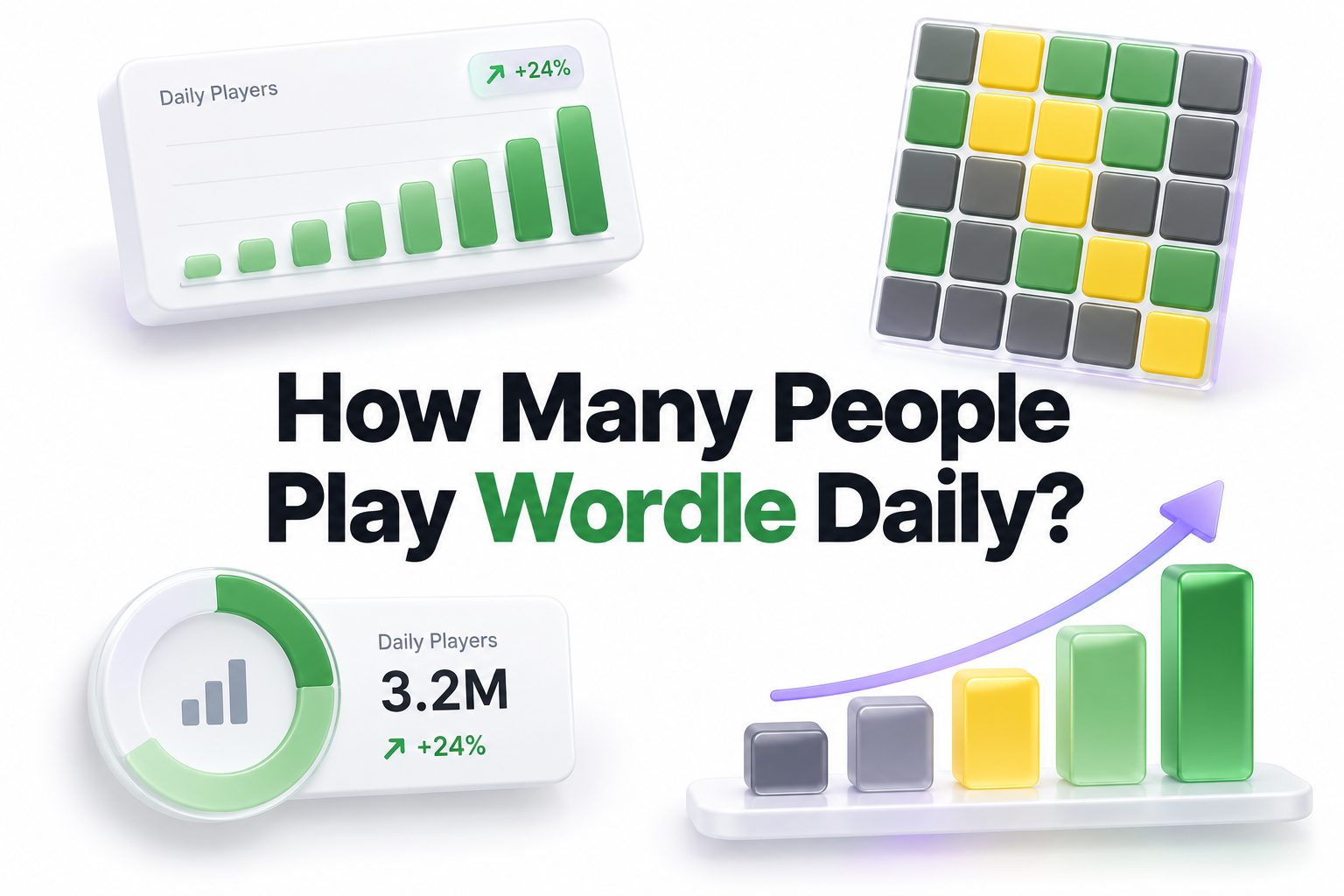
Wordle remains one of the most-played daily word games online, but there is no official live counter showing exactly how many people open it each day. The most defensible answer is that millions of people play Wordle daily, with historical figures suggesting a very large, durable audience rather than a short-lived viral fad. In 2023, the New York Times reported 4.8 billion Wordle plays across the year, which works out to roughly 13 million plays per day on average. A play is not always the same thing as a unique person, so it should not be treated as a precise daily-player count.
For anyone asking how many people play Wordle daily, the key is separating confirmed data from estimates. This article explains what the available numbers can tell us, why an exact figure is difficult to publish, how Wordle’s audience has changed since its breakout moment, and what daily play statistics do and do not mean. It also puts Wordle’s popularity in context with the broader New York Times Games lineup.
How Many People Play Wordle Each Day
A realistic current answer is that Wordle attracts millions of daily players worldwide. The New York Times has not publicly released a regularly updated Wordle-only daily active user figure, so claims that give one exact current number should be read carefully unless they come directly from the company.
The strongest public benchmark comes from the New York Times’ report of 4.8 billion Wordle plays in 2023. Dividing that total by 365 produces an average of about 13.2 million plays per day. That is a useful scale estimate, but it measures completed or recorded game plays, not necessarily 13.2 million different individuals.
Why the Exact Daily Number Is Not Public
Daily active users are commercially sensitive data. Media and gaming companies often share broad milestones, downloads, total plays, subscriptions, or weekly reach while keeping detailed game-by-game audience data private. Wordle is no exception.
There is also no single simple definition of a “player.” One person may play on a phone and computer, replay an archived puzzle, use a different browser, or start a game without finishing it. Analytics systems can reduce duplication, but public totals rarely explain every measurement rule behind the number.
What the Published Numbers Actually Measure
A reported Wordle total can refer to several different things: puzzle plays, visits, completed games, logged-in accounts, or unique devices. Those measures can produce dramatically different results. A daily play total is valuable evidence of engagement, yet it does not automatically equal a count of unique humans.
For practical purposes, it is safest to say that Wordle has a multi-million-person daily audience and has generated millions of puzzle plays per day on average. That wording is accurate without pretending a precise public daily-player total exists.
Important facts about Wordle audience figures:
- A “play” is not always a unique player.
- Daily traffic rises and falls depending on the day, news cycle, holidays, and puzzle difficulty.
- The New York Times reports broader Games performance more often than a Wordle-only audience count.
- Social-media shares capture only a small portion of people who play.
- Third-party estimates can be useful context, but they are not official player counts.
Wordle’s Rise From Small Project to Global Habit
Wordle began as a personal project by software engineer Josh Wardle before becoming publicly available in 2021. Its early growth was extraordinary: the game reportedly went from a tiny audience to hundreds of thousands of daily players within months, largely through its distinctive spoiler-free results grid.
By January 2022, Wordle had become a cultural event. People compared green, yellow, and gray squares on social platforms, discussed starting words with coworkers, and treated the daily puzzle as a shared ritual. The New York Times acquired the game during that rapid rise.
The Viral Peak Was Not the Whole Story
The first months of 2022 produced the game’s most visible viral moment. Interest inevitably cooled after that peak, as it does for nearly every breakout internet trend. A reduced level of online discussion does not mean the game lost its core audience.
Wordle’s format supports long-term habits. It has one new puzzle each day, takes only a few minutes, and gives players a natural reason to return tomorrow. That design helps explain why the game has remained a major part of the New York Times Games business years after its debut.
Why Daily Play Remains Strong
Many games compete for hours of attention; Wordle asks for a brief moment. The six-guess limit makes it easy to fit into a morning routine, commute, lunch break, or evening wind-down. The same solution for everyone also creates an immediate shared reference point.
The puzzle is free to play through the New York Times Games ecosystem, which keeps the barrier to entry low. Regular players can build streaks and track performance, while casual visitors can play without needing to master a complicated ruleset or commit to a long session.
Wordle’s audience has stayed engaged because of several
1. One puzzle per day prevents fatigue from endless scrolling or repeat rounds.
2. The familiar five-letter format is quick to learn but still leaves room for strategy.
3. Shared daily answers make it easy to talk about the game without requiring direct competition.
4. Streaks create a sense of continuity for returning players.
5. The game works well on both mobile devices and desktop browsers.
How Wordle Fits Into New York Times Games
Wordle is no longer a standalone internet novelty. It sits within a wider collection of New York Times games that includes the Crossword, Mini Crossword, Connections, Spelling Bee, Strands, and Sudoku. That larger ecosystem gives players more reasons to visit the Games app or website each day.
The New York Times has said that its games attract more than 10 million daily players across platforms. That number applies to the whole Games portfolio, not Wordle alone. Many people play multiple games in one session, so it would be incorrect to use the broader total as Wordle’s specific daily audience.
The Difference Between Game Plays and People
The distinction matters when interpreting headlines. Suppose one player completes Wordle and then plays the Mini Crossword and Connections. That could create three game plays but still represent one person. If the player uses two devices, analytics may create further complications.
On the other hand, the reported 4.8 billion Wordle plays in 2023 specifically indicates exceptional reach for a single daily puzzle. Even after accounting for repeat sessions, duplicate devices, and measurement differences, the number supports the conclusion that Wordle’s daily audience is substantial.
Comparison of common Wordle popularity measures:
| Measure | What it can show | Main limitation |
|—|—|—|
| Daily plays | Overall activity on a typical day | May include more than one action from the same person |
| Daily unique users | Approximate number of individual players | Usually not publicly disclosed |
| Annual plays | Long-term scale and consistency | Does not show day-to-day changes |
| Social shares | Cultural visibility and discussion | Most players never share results |
| App downloads | Interest in the Games app | Does not prove continued Wordle play |
| Games portfolio users | Strength of New York Times Games overall | Includes people playing other games |
Factors That Change the Number of Daily Players
Wordle does not receive exactly the same traffic every day. Weekends may bring more leisure time for some players, while workday routines may create a different pattern. Holidays, school schedules, major news events, and regional time zones can all affect when and how people play.
Puzzle difficulty can influence conversation and repeat visits, especially when an unusual solution breaks many streaks. A tricky answer may encourage people to compare results, read strategy discussions, or open WordleBot after finishing. It does not necessarily mean more unique people started playing that day.
The Role of Streaks and Social Sharing
Streaks give Wordle a built-in retention mechanism. Missing a day can feel disappointing because a long run resets, which motivates many regular players to check in even during busy periods. The feature is simple, but it turns a casual puzzle into a small personal commitment.
Social sharing helped the game reach its original mass audience, yet it remains useful even after the peak of the trend. Players can post a grid without revealing the answer, compare their number of guesses, and commiserate over an unlucky loss. This makes the game visible without requiring a multiplayer mode.
What Counts as Playing Wordle Today
Most people mean the official New York Times Wordle when they ask about player numbers. Still, many unofficial Wordle-style games exist, including versions built around geography, music, sports, film, countries, and other themes. Those audiences should not be added to the official game’s count.
The official game can be played on the New York Times Games website or through its app environment. It uses one daily answer, six attempts, and color feedback: green for a correct letter in the correct position, yellow for a correct letter in the wrong position, and gray for an absent letter.
A simple way to interpret Wordle participation:
- Count official Wordle separately from clones and themed variants.
- Treat annual play totals as evidence of scale, not a precise unique-player count.
- Use broad language such as “millions of daily players” when no official current figure is available.
- Avoid adding social-media posts, app downloads, and player totals together.
- Check the date attached to every statistic before using it in an article or report.
How to Find Reliable Wordle Statistics
Start with announcements, earnings materials, or newsroom reporting from the New York Times. These sources are closest to the underlying data and are more reliable than blogs that repeat one another’s estimates. Look for the wording around the statistic, especially whether it says “plays,” “users,” “subscribers,” or “downloads.”
Next, check whether a source is discussing Wordle alone or all New York Times games. This is one of the most common sources of confusion. The Games platform has a large combined audience, but Connections, the Crossword, Spelling Bee, and other titles all contribute to that figure.
How to Avoid Misleading Claims
Be wary of headlines that give a specific number without explaining where it came from. A site may calculate a daily average from an older annual total, quote a social-media estimate, or use a third-party traffic tool. None of these methods is automatically wrong, but each has limits.
Dates matter as much as methodology. Wordle’s explosive launch period in early 2022 is not representative of every later month. Likewise, a 2023 annual play total should be presented as historical evidence, not as confirmation of today’s exact audience.
For more context on player habits and answer patterns, an article about [Internal Link: Wordle starting word strategies] can help readers see why some puzzles draw more discussion than others. For broader puzzle comparisons, [Internal Link: best daily word games] is a natural next resource.
Why Wordle Continues to Matter
Wordle proved that a small, well-designed game can build a massive repeat audience without ads, flashy graphics, or unlimited levels. Its success rests on restraint. There is one puzzle, a clear objective, a short session, and enough challenge to make a win feel earned.
It also helped establish daily games as a meaningful audience and subscription strategy for news publishers. The format brings people back frequently, often introduces them to other puzzles, and creates a routine separate from breaking news. For players, the appeal is more personal: a familiar few minutes of focused problem-solving.
Wordle’s Place Among Other Daily Puzzles
Wordle has more mainstream name recognition than most word games, but it is part of a much larger daily-puzzle habit. Connections appeals to pattern spotting, Spelling Bee rewards vocabulary depth, and crosswords offer a longer challenge. Players increasingly combine these games into a personal routine.
That change makes Wordle’s standalone daily count harder to infer from public enthusiasm alone. Some former Wordle-only players now spend time across several games, while newer users discover Wordle through the broader New York Times Games app. The brand remains important even when attention is shared.
Conclusion
The clearest answer is that Wordle is still played by millions of people every day, but no official, constantly updated count of unique daily players is publicly available. The New York Times’ report of 4.8 billion Wordle plays in 2023 offers a strong reference point, averaging about 13 million plays per day across the year. It demonstrates enormous continuing activity, while also reminding us that plays and people are not identical measures.
When assessing how many people play Wordle daily, use careful language. Treat reported play totals as a measure of engagement, distinguish Wordle from the wider New York Times Games audience, and avoid presenting old or third-party estimates as current confirmed facts. Wordle’s audience may be less visibly viral than it was in early 2022, but its daily format, streaks, shared puzzle, and quick gameplay have helped it remain a lasting habit for a global community of word-game fans.
Frequently Asked Questions
How many people play Wordle daily now?
Millions of people play Wordle each day, but the New York Times does not publish a live official count of unique daily players. Historical annual play data suggests a typical daily volume in the multi-million range.
Did Wordle have 13 million daily players?
Not necessarily. The 2023 figure of 4.8 billion plays averages roughly 13 million daily plays. A play count is not the same as a count of separate people, because analytics can include repeat activity.
Is Wordle still popular?
Yes. Wordle is still widely played and remains a major part of New York Times Games. Its public buzz is quieter than its 2022 peak, but millions continue to make the daily puzzle part of their routine.
Does the New York Times reveal Wordle player numbers?
The New York Times occasionally shares broad performance figures, including annual plays and total Games audience metrics. It does not regularly publish a precise, current Wordle-only daily active user number for the public.
Do Wordle shares show total players?
No. Shared score grids show only players who choose to post their results. Many people play privately, while some may share on several platforms, so social posts cannot provide an accurate total player count.
0 Comments